Volkswagen Battery Services in North Charleston, SC
Answers First, Then Battery Service
Southern heat wears out starting batteries faster than winter cold, even though the failure usually shows up on the first cool morning. At Stokes Volkswagen in North Charleston, SC, a slow or silent start is diagnosed before any battery is sold, because corroded clamps, tired cables and loose grounds produce the same symptoms as a worn battery. Our shop covers all makes and models, from economy cars to heavy-duty trucks. Testing covers cranking power, the alternator's output and every connection between the battery and the starter. You hear which part failed the test, with the readings to back it up, before a replacement is discussed.
How Heat and Corrosion Wear Down a Starting Battery
Inside a lead-acid starting battery, lead plates sit in a bath of acid diluted with water, and the chemistry between plate and acid supplies the burst of current the starter needs. Heat speeds up every reaction in that box, including the slow ones that eat away at the plates. Under the hood of a car parked in summer sun, the battery can run much hotter than the air around it, and that heat steadily shortens its life.
The damage builds quietly. High temperatures speed up corrosion of the positive plate grids and drive water out of the electrolyte, and both losses are permanent. A battery that spent several hot summers under the hood may still start the car on a warm afternoon, then give up on the first chilly morning, when the engine oil is thicker and the battery has less to give. The heat did the harm, and the cold simply revealed it.
- Many batteries sit inside a thermal sleeve or under a heat shield, where fitted, to slow the heat soak from a hot engine bay.
- Absorbed glass mat batteries hold their electrolyte in fiberglass mats and are common on vehicles with automatic engine stop at lights.
- The white or blue-green crust on a terminal is corrosion that forms when acid vapor meets the lead and copper of the clamp.
- The negative cable usually runs to the engine block or body, and the vehicle depends on that ground path for every circuit, including the starter.
- The thick positive cable feeds the starter directly, while a smaller wire carries the signal that tells the starter solenoid to engage.
A battery is only as useful as the connections it feeds. Corrosion builds a layer of resistance between the post and the clamp, and that layer can let lights and the radio work normally while choking the far larger flow the starter needs. Cables can also corrode under their insulation, where the damage is hidden, and a ground bolt that loosens over time adds resistance at the other end of the circuit.
Corrosion on the terminals is frequently read as a sign that the battery itself is bad. Light crust is often the result of normal venting or a slightly loose clamp, and once cleaned and sealed, the battery underneath may test perfectly well. Equally, a spotless battery can hide a failing cell. Only a test of the battery by itself, separate from its connections, settles the question.
Patterns That Point to Battery Service
A slower crank than usual is the most common early warning, and in a hot climate it often appears without any cold snap to explain it. The engine turns over with a labored, dragging rhythm, then starts, and the owner forgets about it until the next morning brings the same sound.
Connection problems have their own signature. A single click with dash lights that dim sharply points toward high resistance somewhere between the battery and the starter, while a starter that clicks rapidly can mean the battery has too little cranking power left to hold the solenoid in. Lights that flicker over bumps, or a no-start that cures itself after someone wiggles a cable, nearly always mean a loose or corroded connection.
- A crusty white or blue-green buildup around one or both battery terminals.
- Dash lights that dim sharply the moment the key is turned or the start button is pressed.
- A no-start that clears up after a clamp or cable is moved by hand.
- A battery case that looks swollen or bulged along its sides, often a sign of heat damage.
- A rotten egg smell near the battery after a long trip, often a sign the battery is being overworked.
Not every slow crank is electrical. Thick oil, an engine that is hard to turn for mechanical reasons or a starter motor with worn brushes can all slow cranking with a healthy battery in place. A worn alternator that leaves the battery low after every drive can also make a good battery look bad. Testing each piece separately keeps the replacement aimed at the part that actually failed.
A battery weakened by heat tends to fail suddenly, often far from home or in a parking lot on the hottest day of the year. Corroded clamps and cables also get worse with time, and the extra resistance makes the starter and the alternator work harder. Testing during routine service catches both problems while the fix is still a cleaning or a scheduled replacement.
How We Approach Battery Service
Heat, corrosion and weak connections cause most hard starts in a warm climate, and the three services below address each one.
Heat-Aged Battery Testing and Matched Replacement
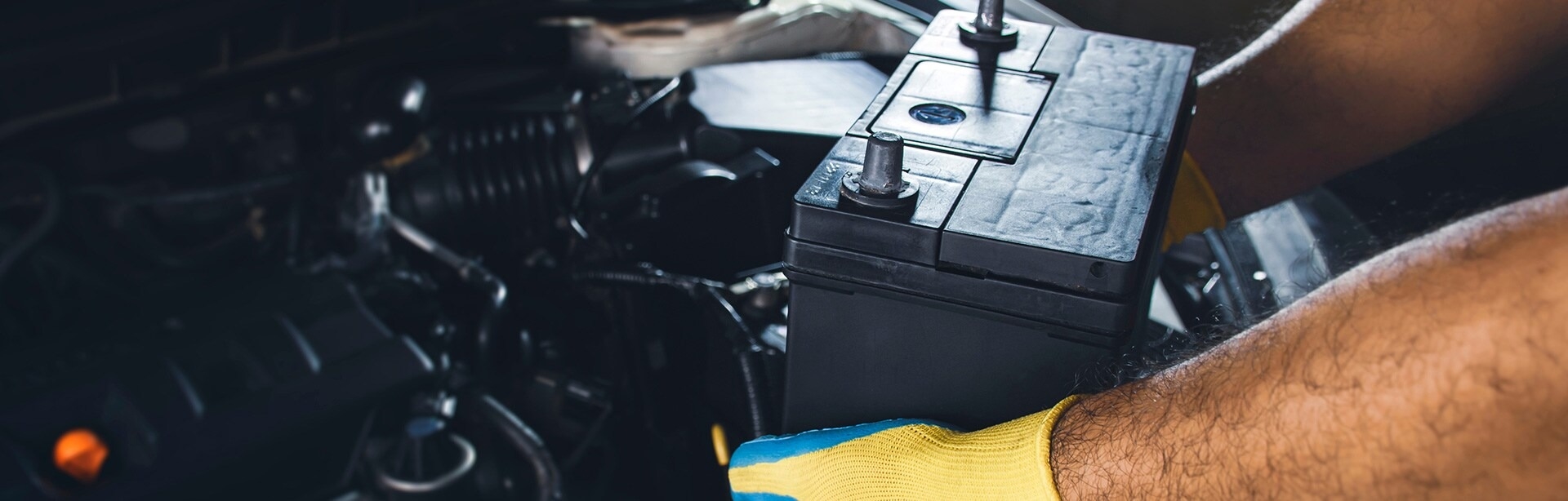
A conductance or load tester reports how much cranking power the battery can still deliver, compared with the rating on its label. The case is checked for swelling, leaks and a missing heat shield. If replacement makes sense, the new one follows the group size, construction and rating the maker specifies, including an absorbed glass mat design where the vehicle came with one. On many newer vehicles, the replacement must also be introduced to the power management module electronically, a step done where required.
Terminal Corrosion Cleaning and Clamp Service
Clamps are removed, and both posts and clamps are scrubbed with a neutralizing solution and a terminal brush until the lead shines. Damaged or cracked clamps are replaced, and the connections are tightened to the correct torque. A protective coating or treated washers can be applied to slow future buildup. The hold-down bracket gets a look in the same visit, because a battery that can shift may rub, crack and leak.
Starter Cable and Ground Connection Testing
With the starter cranking, the technician measures how much energy is lost along each cable and at each ground connection, which reveals resistance that a visual check would miss. The positive cable to the starter, the negative cable and the engine and body grounds are each tested separately. A cable with corrosion under its insulation or a ground bolt that has loosened is repaired or replaced. The starter's own draw can be checked in the same session to see whether the motor itself is working too hard.
Battery Testing in the Order It Happens
The visit begins with a few questions about when the trouble shows up, how old the battery is if you know, and whether the vehicle has needed a jump. The technician then looks at the battery, clamps and cables before connecting any tester, since visible corrosion or a loose clamp changes how the readings are interpreted.
The owner of a delivery van arrived certain the battery was finished after weeks of sluggish cranking on hot afternoons, since it had been through a few summers. The battery passed its load test with a strong result. With the starter turning, a meter across the negative ground cable showed a large loss over a short length of wire. Peeling back the insulation near the clamp revealed green corrosion that had wicked well up inside the cable, invisible from outside. A new negative cable restored a brisk start, and the original battery stayed in the van.
- The battery is tested on its own, with the clamps cleaned first, so a poor connection cannot drag the result down.
- The alternator's output is measured at idle and with lights and the blower running, confirming it can keep pace with what the vehicle uses.
- Each cable and ground is checked under cranking load, where hidden resistance shows up.
- Results and prices are shared with you first, and repairs begin only once you agree.
Once the work is finished, cranking speed is judged by ear and by meter across a series of starts, and the alternator's output is read again with accessories running. The hold-down is snugged, a protective film goes on the terminals and the clamps get a last tug before the hood closes.
Early appointments help with battery work, because a vehicle that has sat overnight shows its true cranking behavior on the first start of the day. Our North Charleston service lanes take all makes and models. Testing and most replacements are handled before the morning is out when the schedule and parts allow. A battery or cable that needs ordering is flagged before work begins.
Trusted by Owners Around North Charleston for Battery Care
Battery energy management is built into many Volkswagen models, and the Stokes Volkswagen technicians who completed Volkswagen factory training account for it whenever a battery is tested or replaced. On many recent Volkswagens a replacement battery has to be coded to the vehicle with Volkswagen diagnostic software, so the energy management system knows its type and capacity and can protect it.
On an Atlas or a Jetta, the battery often sits under an insulating sleeve, where fitted, which goes back on after any replacement to keep engine heat away. Vehicles with automatic engine stop typically need an absorbed glass mat battery, and the VIN confirms what yours requires.
- A battery from the Volkswagen parts catalog can be ordered if you want the factory type back under the hood.
- Battery coding and any stored energy management faults are handled in the same visit.
- Your Volkswagen service file records the battery test result and the date code of the battery installed.
Find Stokes Volkswagen in North Charleston, SC
The Map of Our Battery Service Customers
Parking lots along Rivers Avenue and around Northwoods bake in full sun through the long summer, and vehicles that sit there for a shift absorb heat from the pavement and the engine bay alike. Batteries in those cars age faster than the calendar suggests, and many North Charleston drivers bring their vehicles to Stokes Volkswagen for a test before the first cool morning catches them out.
- Hanahan, SC
- Daniel Island, SC
- Summerville, SC
- Moncks Corner, SC
- James Island, SC
- Mount Pleasant, SC
- Ladson, SC
- West Ashley, SC
A battery test fills a short slice of a visit and shows whether the battery, its clamps or its cables need attention. The answer can spare you a new battery when a corroded wire is the real fault.
Answers on Battery Service Near North Charleston
These battery and connection questions come up often at our service desk.
Q: Why do car batteries seem to fail faster in hot weather?
Q: Is it safe to clean battery corrosion myself?
Q: What does a single click mean when I try to start the engine?
Q: How do I know if my battery needs replacing or just cleaning?
Q: My household drives several brands; can every one of them get a battery test here?
A recent jump start is worth mentioning at booking, along with whether the start was slow or silent.
Knowing the battery's rough age helps the technician read the test results.
Schedule a Look at Your Battery
Heat damage inside a battery cannot be reversed, and corroded connections only get worse. A test now lets you replace a weak battery or clean a crusted clamp on your schedule, not in a parking lot.
The readings are shared with you before any part is chosen, and each repair is priced on its own. A battery that tests well stays in place.
Owners who suspect a weak battery can reserve a test with Stokes Volkswagen through the website. If the car is already struggling to start, say so when booking, and the visit can be planned so the vehicle is not stranded.
Service Specials

Vehicle Diagnostics

Brake Pad & Rotor Replacement

Legacy VW Diagnostic Special

VW Battery Inspection

Premium Oil Service
VW Air Filter Special

Volkswagen Alignment
Brake Fluid Exchange

Take care of your VW now through December 31, and choose a gift card from hundreds of top brands.